


 Users’ rights on platforms and online marketplaces
The Digital Services Act (DSA)
Same rights online as offline
 DSA makes advertising much more transparent
 I can shop more safely with DSA and get real help if something goes wrong
 Thanks to DSA, I’m less worried about children’s safety online
 I can easily report illegal content online and get feedback
 I get a clear explanation with the DSA why they deleted my content or blocked my account
What to do if you have a problem
 01
First try to communicate your concerns directly to the provider, including any appeal you may have
 02
You can then go to a court or out-of-court dispute settlement body
03
Alternatively, a complaint may be submitted to the CTU:
Please indicate which provider is concerned by the problem
Describe what happened
Document as much evidence as possible – e.g. copies of communication with the provider
FAQ
How will illegal content be reported and who will decide whether the content is illegal?
Under the DSA, every user will be able to report illegal content on the platform. Unlawfulness is determined by existing EU or national legislation. Both the notifier and the recipient concerned shall be informed of the possibilities of redress. If the provider does not act after the announcement, it becomes co-responsible for the content, and any affected recipient of the service can claim damages from it. The parties may refer any disputes to a court or a specialised out-of-court dispute settlement body.
How will the CTU ensure transparency of online intermediary services and how will this affect smaller businesses?
The CTU will check, among other things, whether providers publish content moderation reports, the number of disputes handled or the number of users. However, small and medium-sized enterprises (SMEs) are exempted from the obligation.
Does the DSA define illegal or disinformation content?
Illegal content is defined not by the DSA but by EU or national law. These are particularly serious acts such as hate speech, discrimination, terrorism, trafficking in human beings, illicit drug or arms trafficking, etc. Content illegalities will be assessed by the providers themselves if they become aware of them. A public authority may also impose measures against illegal content if it has the power to do so under a specific law. The DSA does not explicitly define disinformation content. Articles 34 and 35 of the DSA refer only to the obligation for very large platforms to take measures against systemic risks with adverse effects on fundamental rights and civic [DL1] discourse. The adequacy of these measures will be assessed by the European Commission.
Will the CTU decide on the illegality of the content and order its removal?
No. The CTU will assess compliance with the DSA procedures. The illegality of the content shall be governed by Union or national law and shall be assessed by the providers in accordance with their internal rules and applicable legal standards. The illegal content must be removed by the provider. The parties may refer any disputes to a court or a specialised out-of-court dispute settlement body.
Where can I find an overview of Very Large Online Platforms (VLOPS)?
The European Commission provides an overview of designated Very Large Online Platforms (VLOPS) and Very Large Online Search Engines (VLOSEs) under the supervision of the EC and the main enforcement activities. Available here: https://digital-strategy.ec.europa.eu/en/policies/list-designated-vlops-and-vloses#ecl-inpagewebgroupcz.
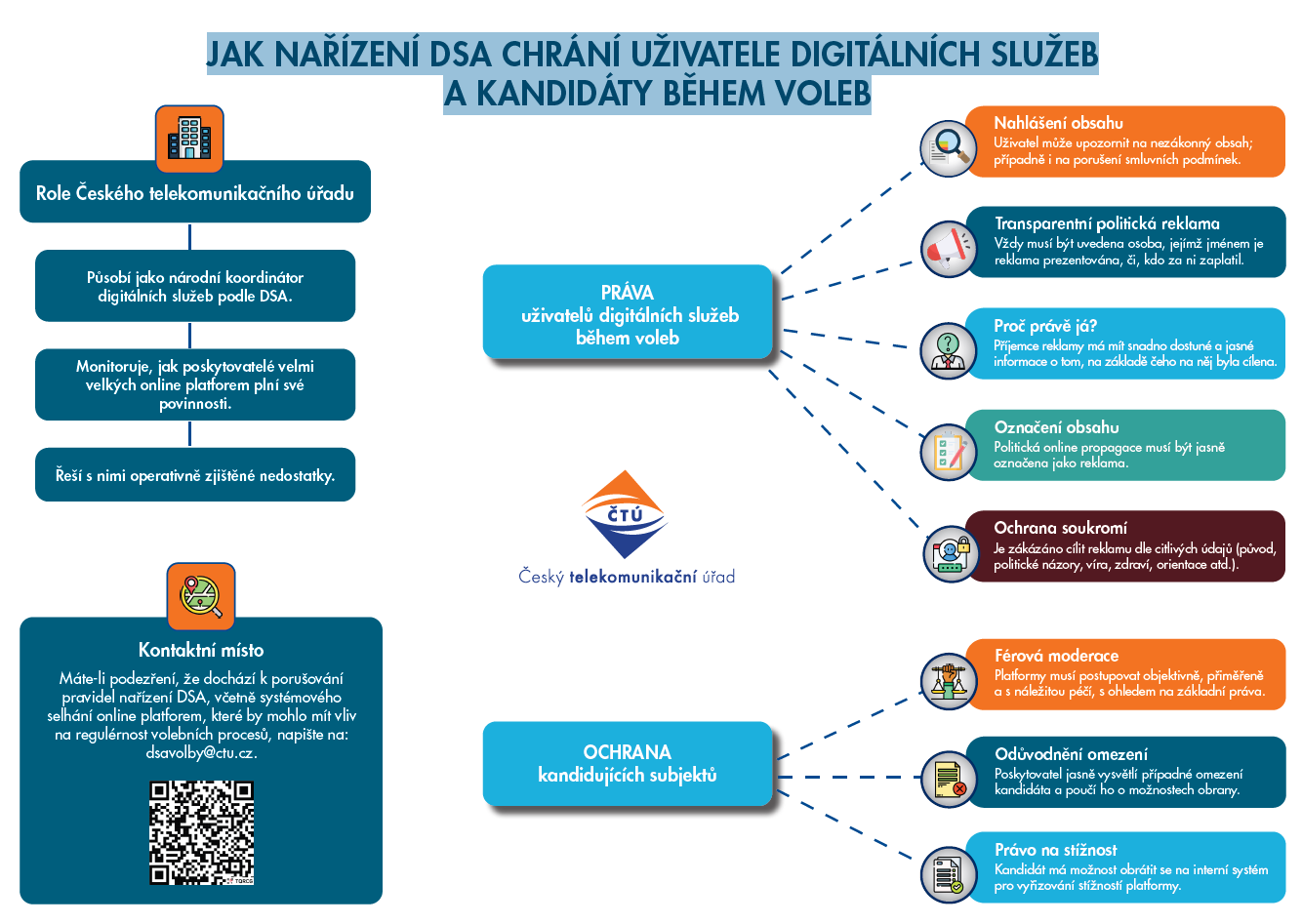
How does the DSA protect users of digital services and candidates during elections?
Check out the infographic to see how the DSA protects both users of digital services and candidates during elections.
Stáhnout PDF.